




















Rethink How You Prospect with Critical Sales Prospecting Skills.
Today’s marketplace requires smarter, more efficient targeted prospecting and qualifying that fills the pipeline with quality prospects. To reach modern customers, your team needs Critical Sales Prospecting Skills.
Critical Sales Prospecting Skills are a proven prospecting methodology that teaches sales professionals to consistently reach, qualify, and interact with viable prospects in order to keep the pipeline well-stocked and achieve your sales goals.

The Importance of Sales Prospecting Training
Prospecting is primarily a numbers game. The more individuals salespeople target, the more likely they are to find interested and qualified buyers. However, taking such a broad approach, which often involves endless cold calling, wastes valuable time and doesn’t yield the best return on investment.
Learning how to prospect for sales enables salespeople to implement a targeted approach that is more efficient and effective. They’ll be more likely to connect with buyers who can benefit from their products and services instead of spinning their wheels trying to reach the wrong people.

Hear What Our Clients Say About Us

Download the Brochure
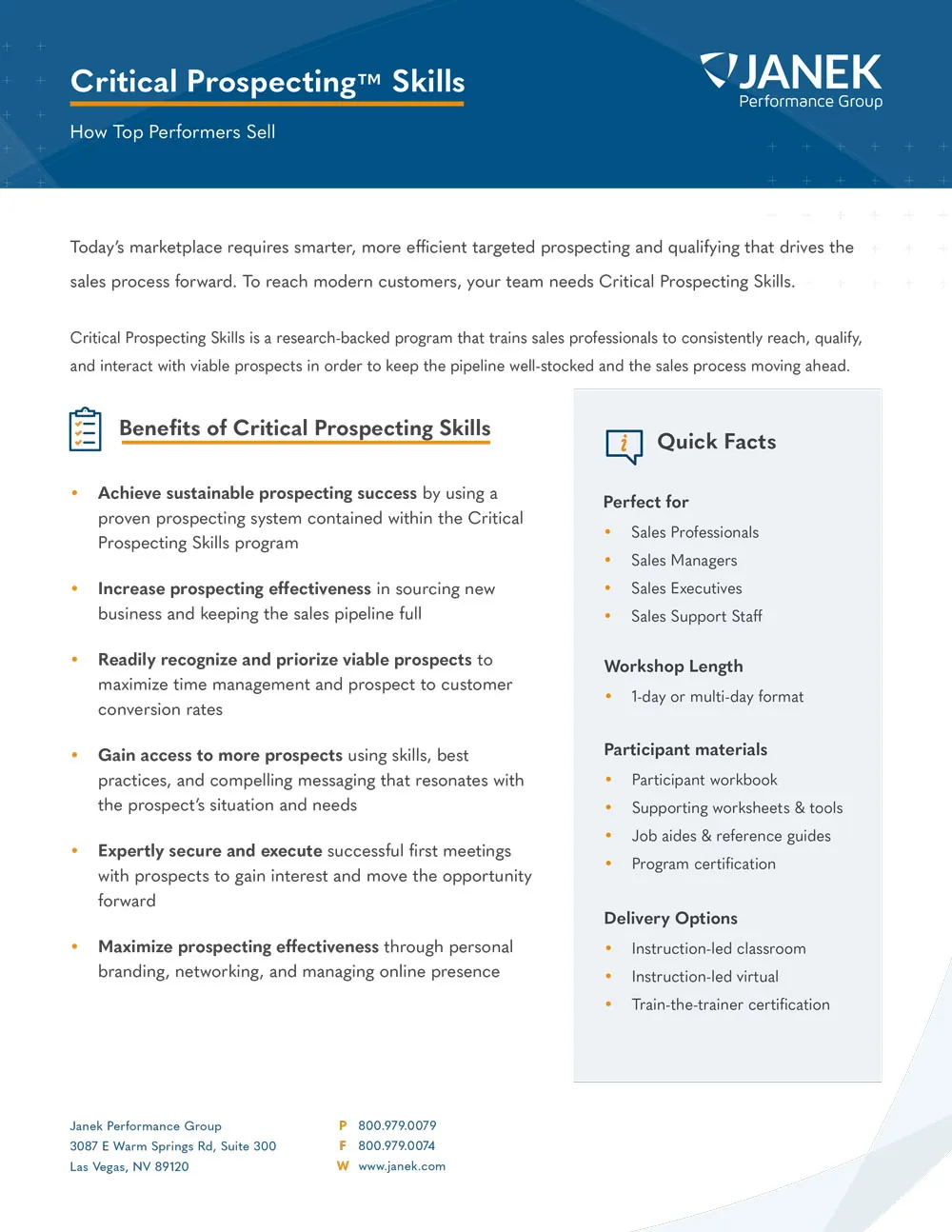
More information about the Critical Prospecting Skills program is available in this downloadable PDF.
Critical Prospecting™ Skills FAQ
A company can have the best products or services on the market, but these will have little meaning or value without customers. It’s up to salespeople to find buyers and persuade them to make purchases.
Sales prospecting is the process of locating and reaching potential customers who have a need for the seller’s products or services. It also entails qualifying the individual or organization to ensure they have the resources to complete a purchase.
Janek clients enjoy an average ROI of 1293% from the entire range of Janek sales training programs. Our sales prospecting training programs impart a sustainable, consistent framework for effective prospecting.
Jenius CC provides ongoing feedback and practice opportunities to strengthen outreach messaging, objection handling, and lead qualification skills.
Effective prospecting strategy has evolved over time. At Janek, we routinely refresh and update our sales prospecting training course with new information derived from market research and extensive in-field training.
Janek’s approach to prospecting improves the ability of a salesperson to target the right kind of prospects. Effective prospecting focuses on decision makers and qualified potential customers, and Janek’s training programs build on that core framework. Our programs emphasize leveraging social media as a fundamental prospecting technique and set sellers up for success.
The ideal target audience for Critical Prospecting is anyone who is responsible for identifying and pursuing new business opportunities. This can range from an individual sales leader to an account manager or entire team responsible for new business outreach. Specifically, Janek recommends Critical Prospecting for business development representatives, sales reps, account managers, executives, and anyone involved in filling the sales pipeline.
Janek’s Critical Prospecting Skills program teaches prospecting techniques that include cold calling, in-person outreach, leveraging social media, networking skills, personal branding, and sales prospect pursuit strategy.
Effective prospecting combines multiple techniques: (1) Research & Targeting – identifying high-fit accounts and decision-makers based on company fit, recent signals, and buying intent, (2) Multi-Touch Outreach – reaching out across email, LinkedIn, phone, and warm introductions rather than relying on a single channel, (3) Value-First Messaging – leading with specific value or insight relevant to their situation, not generic pitches, (4) Upfront Contracting – clarifying expectations and timeline in initial conversations to disqualify poor fits early, (5) Persistence with Respect – following up consistently without being pushy, (6) Real Conversations – moving from email to phone or video quickly to build relationship. No single technique works alone; combination is key.
Critical Prospecting™ is a structured approach to identifying and qualifying leads that begins with Pre-Work (research, positioning, and target list building), moves through Contact (multiple outreach touches across channels), includes Qualification (using an upfront contract to confirm fit and timeline), and concludes with Lead Submission (warm handoff to Account Executives). The methodology emphasizes quality targeting, multi-touch persistence, and clarity on prospect buying signals rather than volume-based prospecting. Traditional prospecting often focuses on dial volume and number of touches; Critical Prospecting™ focuses on quality conversations and real qualification.
Effective prospecting structures follow this sequence: (1) Pre-Work Phase – define your Ideal Customer Profile (ICP), research target companies, identify decision-makers, and customize your positioning, (2) Initial Contact – first touch via email or LinkedIn with research-backed personalization, (3) Multi-Touch Cadence – planned sequence of touches across channels over 3-4 weeks (email, LinkedIn, phone, social mention, warm intro request), (4) Qualification Conversation – move to real conversation to assess fit and timeline using upfront contract framework, (5) Hand-off – warm introduction to appropriate sales resource when qualified. This structure moves from volume to quality and from outreach to opportunity.
It typically takes an average of 8 touches across different channels to get a prospect’s attention. Yet, most sales reps stop outreach after 2 or 3 attempts. To stand out, reps need a multi-channel cadence (combining email, phone, and social selling) over 3–4 weeks. Success relies on delivering unique value with every contact attempt, rather than sending repetitive follow-ups.
Absolutely. Virtual prospecting includes: LinkedIn research and outreach, email cadences, video messages for higher engagement, LinkedIn voice notes, virtual coffee meetings (Zoom), and phone calls. Some argue virtual prospecting is more efficient because geographic constraints disappear. However, it requires more intentional relationship-building and differentiation since prospects receive high volumes of virtual outreach daily. The fundamentals—good research, personalization, multi-touch persistence, and real conversation—apply equally to virtual prospecting.
Prospecting training drives ROI across all complex B2B sales environments, but especially in: (1) Professional Services – consulting, law, accounting firms that rely on business development, (2) Enterprise Software/SaaS – organizations with long sales cycles and multiple stakeholders, (3) Financial Services – banking, investment, insurance where relationship-building is core, (4) Manufacturing/Industrial Products – companies selling to multiple decision-makers in buying committees, (5) Technology Solutions – firms selling to procurement and technical teams simultaneously. Any industry with consultative selling, longer sales cycles, and multiple decision-makers sees significant prospecting training ROI.
Prospecting training drives pipeline improvement through four mechanisms: (1) Increased Volume – trained reps prospect more consistently and systematically, generating more qualified conversations, (2) Improved Quality – better targeting and qualification mean fewer unqualified deals in pipeline and higher conversion rates, (3) Reduced Sales Cycle – consistent prospecting activity means continuous flow of deals at various stages, reducing feast-famine cycles, (4) Higher Win Rates – reps who prospect from relationship-building stage (not crisis stage) close at higher rates because they influence from early. Within 60-90 days of prospecting training, most organizations see 15-20% pipeline growth and improved deal velocity.