



























Selling Virtually™

Learn the strategies, skills, and best practices in the “new normal” of modern selling in a virtual ecosystem.
Rethink How You Connect Virtually with Customers
Virtual selling is here to stay. Sales professionals must quickly master a new skillset and a new set of best practices to establish advantage and win more in modern B2B and B2C selling situations. Sales professionals must create an effective virtual stage and apply virtualized approaches to engage customers and prospects with the same professionalism and success as in-person interactions.
Selling Virtually is research-based and purpose-built to enable robust virtual selling skills that boost productivity, enhance sales effectiveness, energize customer engagement, extend new and existing relationships, and achieve better sales outcomes. Selling Virtually is appropriate for all sales roles in all industries anywhere in the world. Additionally, it is appropriate for any customer-facing role and any role with customer touchpoints.

Key Benefits of Selling Virtually

Program Objectives of Selling Virtually
The Importance of Remote Selling Training
While remote selling is rapidly becoming a preferred method for interacting with customers and prospects, it can be a challenging transition for traditional salespeople. Comprehensive training provides a practical and cost-effective solution for developing and mastering essential virtual selling skills.
As virtual selling relies heavily on various technologies, it requires a different approach than when sitting in front of prospects or conversing with them on the telephone. Effective training ensures salespeople can harness the power of the internet, email, video conferencing and other technological platforms and combine them with the traditional people-based selling fundamentals like making engaging presentations, overcoming objections and closing the deal.
Hear What Our Clients Say About Us






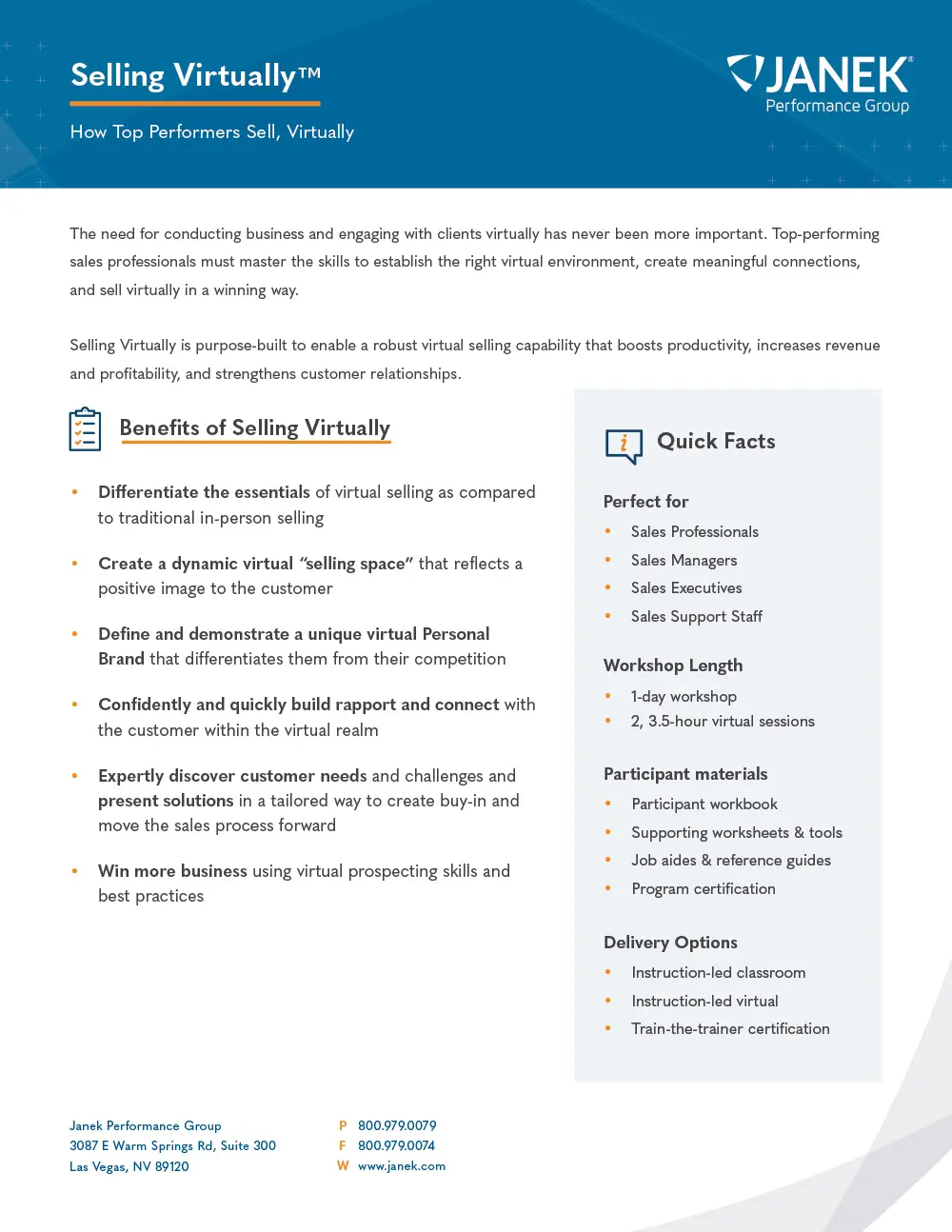
Download the Brochure
More information about the Selling Virtually program is available in this downloadable PDF.
Selling Virtually™ FAQ
All in all, Janek partners enjoy an industry-leading 1188% ROI across our entire portfolio of sales training programs based on training delivered in 2023. Selling Virtually is aimed at those sales professionals who need to improve their digital and remote selling experiences. Whether you’re hosting virtual events, running virtual sales meetings, or simply engaging with potential buyers, Selling Virtually will help you succeed in today’s remote selling environment.
All of Janek’s sales training programs are refreshed regularly based on quality market research and field-proven methodologies. Selling Virtually was revisited most recently in 2023.
Janek’s Virtual Selling program helps sales professionals and sales leaders increase the volume of virtual meetings, build trust and rapport with prospects, and communicate more effectively during the virtual sales process. By following the virtual best practices that Janek imparts during the Selling Virtually program, your sales team will perform better in today’s virtual world.
The Selling Virtually Readiness Diagnostic is a framework of virtual selling best practices that gauges your ability to sell virtually. We will also provide your team with the tools they need to self-assess their remote selling capabilities and identify areas for improvement. At Janek, we have built a consistent set of virtual selling best practices that are proven to build trust and increase your virtual presence.
Achieving virtual selling success requires a different approach than traditional face-to-face sales. Mastering these fundamentals can help salespeople attain favorable outcomes.
- Develop a Process
As with traditional face-to-face sales, success when selling virtually requires creating an effective process and adhering to it closely. While the steps may vary slightly, this methodology should include prospecting, qualifying, presenting and closing. Determine which communication type is most appropriate for each process step. - Create a Virtual Selling Space
Utilize technology to create an inexpensive but effective virtual selling studio to make a favorable impression on prospects. Consider setting up a background wall featuring your company’s logo or brand. Position a high-quality external camera to provide a wide field of view, and make sure the lighting is appropriate for the setting. Use a boom microphone to ensure a clear audio presentation. - Eliminate Background Noise
Extraneous noise can distract the customer or prospect, making it more difficult to establish a connection and convey your message. A boom-style mic, such as those used by many podcasters, is an effective tool for screening unwanted sounds. Software that removes background noise and echoes is also available. - Engage the Prospect
Keeping the listener engaged can be more challenging in virtual selling than during in-person sales presentations because there is less human contact. As a salesperson, you can hold the prospect’s attention by employing tactics like using visual aids and initiating interactive discussions. If you’re selling to multiple prospects, consider holding a Q&A session to respond to chat inquiries submitted during the presentation. - Incorporate Storytelling
Storytelling is an effective method in all types of sales processes, including virtual selling. While the primary approach should be educational, telling a story makes the information more personal and helps establish a genuine connection. It also enables prospects to identify with your product or service and “feel” their benefits. - Practice Active Listening
Your virtual sales process should be a two-way street, with opportunities for the prospect to participate. Include frequent pauses in your presentation to allow for listener questions and feedback. Observe nonverbal cues to gauge the listener’s attention and interest. - Follow Up
After completing your presentation, send a written summary of the main points to the listener and include the next steps in the process. This step ensures everyone is on the same page and helps prevent miscommunications that could derail the sale.
Virtual selling is fundamentally different in several ways: (1) Rapport Building – you can’t shake hands or read full body language; you must build trust through voice tone, eye contact on camera, and authentic conversation, (2) Attention Control – you compete with email, calendars, and multitasking; your opening and presence must be stronger, (3) Visual Communication – slides, screen shares, and video presence replace physical whiteboards and in-person energy, (4) Technology Barriers – technical difficulties, poor audio, bandwidth issues can derail conversations, (5) Pacing – video fatigue means you need to move conversations faster and break monotony, (6) Objection Handling – you can’t move closer, adjust body language, or use physical presence to overcome resistance. These differences require specific skills beyond traditional consultative selling.
Virtual rapport requires intentionality: (1) Eye Contact – look at the camera, not the screen, to create direct connection, (2) Voice and Tone – warm, conversational tone carries more weight than in-person presence; slow your pace slightly, vary inflection, (3) Authenticity – be human; acknowledge the medium (“I know Zoom fatigue is real”), share appropriate personal detail, show genuine interest in the person, (4) Engagement – ask questions, encourage input, make them feel heard through active listening, (5) Minimizing Distractions – professional background, eliminate notifications, show you’re focused entirely on them, (6) Opening Strong – a genuine, personalized opening sets rapport tone immediately. Rapport over video is built through clear communication, active listening, and authentic presence more than visual cues.
Absolutely yes. Many organizations now close six-figure deals entirely virtually. The key differences from in-person closing: (1) Earlier Commitment – in virtual selling, you often close smaller commitments earlier (discovery meeting, proposal review) because you need intermediate steps to build trust, (2) Explicit Language – you must verbally confirm agreement since you can’t read non-verbal cues; say “Does that work for you?” rather than assume nods, (3) Document Sharing – screen-share contracts, pricing, next steps so everyone sees the same information simultaneously, (4) Follow-up Documentation – send written confirmation immediately after the call capturing all agreements, (5) Executive Presence – your professionalism, preparation, and command of your topic matter more in virtual format. Virtual closing requires confidence, clear language, and explicit confirmation.
Core technology requirements: (1) Video Platform – Zoom, Teams, WebEx (your customer’s preference matters most), (2) Quality Webcam and Microphone – invest in good audio/video; poor quality undermines credibility, (3) Professional Background – virtual or real background that’s distraction-free, (4) Screen Sharing Capability – ability to present slides, share screens, show documents, (5) CRM Integration – access to customer information during calls so you’re not fumbling for details, (6) Recording Capability – record calls (with permission) for coaching and compliance, (7) Dialing Infrastructure – whether phone dial-in, VOIP, or video dial, have backup audio option if video fails. Optional but valuable: document collaboration tools (Google Docs, shared workspaces), interactive presentation tools beyond static slides, screen annotation tools. Technology enables selling; sales skills matter most.
Virtual presentation effectiveness requires: (1) Slide Discipline – fewer words per slide, larger fonts, high-contrast colors, visual storytelling rather than text-heavy content, (2) Pacing – move through slides faster than in-person to hold attention; pause for questions more frequently, (3) You vs. Slides – share screen briefly for impact, then go back to gallery view to maintain face-to-face connection; don’t let slides become the focal point, (4) Visual Variety – mix slides with screen shares, live demos, customer examples, video clips; monotone presentation kills virtual engagement, (5) Interactivity – ask questions, use polls, encourage input rather than broadcasting; two-way conversation outperforms presentation, (6) Energy Level – appear more engaged on camera than you would in person; camera flattens natural energy, so you must compensate. Virtual presenting is about clarity, visual simplicity, and active engagement more than impressive slides.
Selling Virtually™ is offered in multiple formats to fit different preferences and organizational needs: (1) Instructor-Led Virtual Workshop – live 1-2 day program with video classroom, breakout rooms for role play, real-time practice and feedback, (2) In-Person Workshop – classroom delivery with video selling emphasis; participants learn while practicing on camera, (3) Blended Approach – combination of live workshop plus virtual reinforcement via TOPS® or micro-learning modules, (4) Janek OnDemand – self-paced online modules participants complete individually, ideal for dispersed teams or asynchronous learning, (5) Train-the-Trainer Certification – internal facilitators learn to deliver Selling Virtually™ to ongoing cohorts. Most organizations combine initial training (1-2 days) with 90+ days of reinforcement and manager coaching to ensure skill transfer and habit formation.
Virtual objection handling requires adapted techniques: (1) Listen Completely – resist the urge to interrupt; let them finish, then pause 2-3 seconds before responding (silence feels shorter on camera), (2) Validate First – acknowledge their concern genuinely before countering: “I understand why that’s important,” not defensive pushback, (3) Get Specific – “Tell me more about what concerns you” surfaces the real objection beneath surface resistance, (4) Visual Support – screen-share relevant case studies, data, or customer examples to address objections with evidence, (5) Stay Composed – your tone and facial expression matter more on camera; stay calm and positive even if they’re frustrated, (6) Clarify Agreement – once you’ve addressed an objection, explicitly confirm: “Does that address your concern?” rather than assuming, (7) Move Forward – don’t dwell on objections; after resolving, move confidently to next step. Virtual objection handling is 70% about tone and presence and 30% about content.
