


















AI Sales Enablement Framework: A Practical 5-Step Approach to Drive Adoption and Performance
 Greg Smith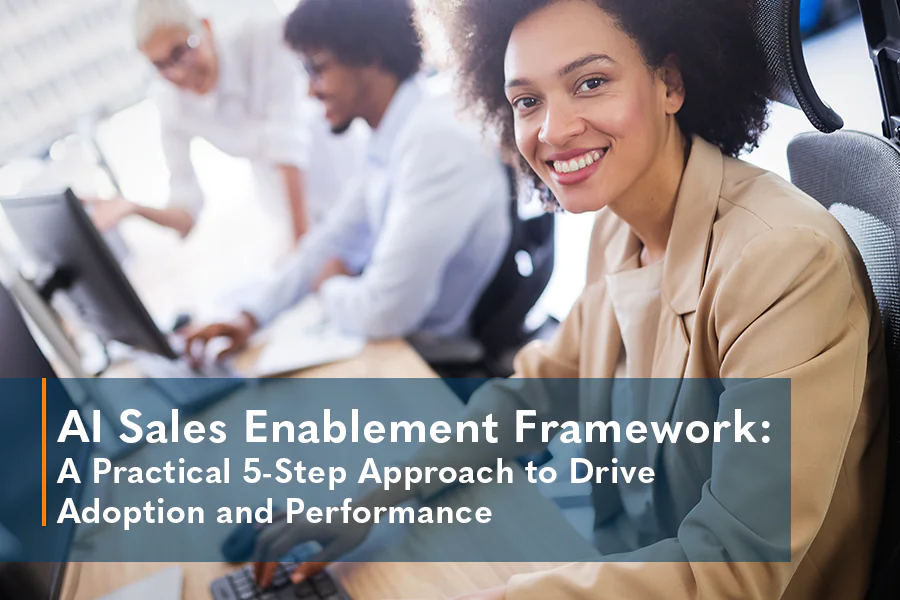
Artificial intelligence is reshaping sales enablement.
From AI sales coaching to real time conversation practice, the potential is clear. But here is the reality most leaders discover quickly: AI does not fail because of the technology. It fails because of adoption.
In fact, recent industry research shows that nearly half of AI projects are abandoned before reaching production, often because organizations cannot embed them into daily workflows or measure meaningful impact.
Too many companies launch AI powered sales enablement tools with excitement, only to watch usage stall. Sellers ignore it. Managers do not reinforce it. Executives struggle to measure impact.
The difference between success and shelfware is not speed. It is structure.
This practical 5 step AI sales enablement framework is designed to help organizations roll out AI in a way that drives real behavior change, sustained adoption, and measurable performance improvement.
Why AI Sales Enablement Adoption Breaks Down
AI accelerates what already exists:
- If expectations are unclear, AI scales confusion.
- If coaching is inconsistent, AI reinforces inconsistency.
- If managers are disengaged, AI becomes optional.
AI powered sales coaching works best when it strengthens a clearly defined sales process and execution model. Without that foundation, even the most advanced platform will struggle to create impact.
That is why rollout strategy matters.
The 5 Step AI Sales Enablement Framework
Step 1: Assess Sales Readiness Before Deploying AI
Before introducing any AI sales enablement tool, assess organizational readiness. Consider:
- Is sales leadership aligned and actively sponsoring this initiative?
- Is your sales process clearly defined?
- Do managers consistently coach to the same standards?
- Is there clarity around what strong performance looks like?
AI sales coaching technology amplifies your current standards. If those standards are unclear, the technology cannot fix that. AI should scale clarity, not compensate for its absence.
Step 2: Start With One Team Instead of the Entire Organization
One of the most common AI implementation mistakes is launching across the entire sales force at once. Instead, choose:
- One team, role, or region
- Clear and measurable success criteria
A focused rollout allows you to test workflows, refine expectations, and build proof points before scaling. Early wins create credibility. Credibility creates momentum.
When the first team demonstrates improved execution and measurable performance lift, expansion becomes easier and less risky.
Step 3: Establish a Clear Sales Execution Process
Technology does not drive behavior. Process does. Successful AI sales enablement supports a repeatable execution loop:
- Prepare: Sellers understand expectations and what strong execution looks like.
- Practice: Sellers rehearse skills and conversations in a structured, low risk environment.
- Perform: Sellers apply those skills in live customer interactions.
- Progress: Managers reinforce strengths and coach next step improvements.
When AI aligns with how sellers prepare, practice, perform, and improve, it becomes embedded into daily workflow instead of feeling like an extra task. This is where adoption becomes sustainable.
Step 4: Train the AI With Your Sales Process and Messaging
AI is only as effective as the standards behind it. To drive meaningful sales performance improvement, your AI platform must understand:
- Your sales methodology
- Role specific scenarios
- Messaging frameworks and value propositions
- Real examples from top performers
Generic AI delivers generic feedback. When AI reflects your real-world selling motion, it reinforces the conversations and behaviors that drive revenue inside your organization.
Step 5: Use AI During Sales Training, Not After
One of the biggest missed opportunities in sales enablement is waiting until training ends to introduce reinforcement tools. AI should be embedded into sales training and onboarding from day one.
When AI is used during training, sellers can:
- Practice new skills immediately
- Receive structured, consistent feedback
- Continue learning beyond the classroom
This shortens ramp time, improves retention, and prevents skill fade once sellers return to the field. Training should not be an event. It should be continuous. AI makes continuous coaching scalable.
Crawl, Walk, Run: Scaling AI in Sales Organizations
This AI sales enablement framework follows a clear progression:
- Crawl: Assess readiness and focus deployment.
- Walk: Build execution habits through structured practice and reinforcement.
- Run: Scale AI driven coaching into everyday selling.
Organizations that succeed with AI powered sales coaching are not the ones that move the fastest. They are the ones that operationalize it with discipline. AI is not the strategy. It is the engine that scales the strategy you already believe in.
Final Thoughts
AI sales enablement can deliver measurable performance lift, faster ramp time, and scalable coaching impact. But only when adoption is intentional. If you are exploring AI sales coaching or enablement platforms, start with structure:
- Align leadership
- Clarify expectations
- Pilot intentionally
- Reinforce execution daily
- Embed AI into training
When AI supports how sellers work every day, it stops being new technology. It becomes a competitive advantage.

The 5-Step Executive Framework
A phased executive framework for operationalizing AI-powered sales enablement without overwhelming your organization.


- Why AI Sales Enablement Adoption Breaks Down
- The 5 Step AI Sales Enablement Framework
- Step 1: Assess Sales Readiness Before Deploying AI
- Step 2: Start With One Team Instead of the Entire Organization
- Step 3: Establish a Clear Sales Execution Process
- Step 4: Train the AI With Your Sales Process and Messaging
- Step 5: Use AI During Sales Training, Not After
- Crawl, Walk, Run: Scaling AI in Sales Organizations
- Final Thoughts
- The 5-Step Executive Framework

- Account Planning (11)
- Awards (55)
- Client Testimonial (39)
- Personal Branding (19)
- Podcast (12)
- Research (70)
- Sales Career Development (85)
- Sales Coaching (159)
- Sales Consulting (135)
- Sales Culture (164)
- Sales Enablement (353)
- Sales Leadership (112)
- Sales Management (245)
- Sales Negotiation (16)
- Sales Prospecting (120)
- Sales Role-Playing (19)
- Sales Training (240)
- Selling Strategies (256)
- Soft Skills (68)
- Talent Management (92)
- Trusted Advisor (28)
- Virtual Selling (42)
- Webinar (13)


