


























How Sales Training Reinforcement Ensures Retention
 Justin Zappulla
- Why Is Sales Training Alone Insufficient?
- What Is Sales Training Reinforcement Learning?
- How Sales Training Reinforcement Boosts Retention
- What Are the Types of Sales Training Reinforcement?
- What Are the Key Benefits of Reinforcing Sales Training?
- 1. Improves Performance and Job Satisfaction
- 2. Boosts Confidence
- 3. Maintains Accountability
- 4. Improves Companywide Alignment
- 5. Makes Staff Feel Valued
- 6. Strengthens Work Relationships
- What Are Strategies for Reinforcing Sales Training?
- Final Thoughts
Sales employees work in a high-pressure environment. When they lack proper training to feel confident and comfortable in their roles, it increases their likelihood of struggling with job dissatisfaction and pressure, which can lead to higher turnover rates.
Well-structured, customized sales training programs equip sales teams with the practical skills needed to succeed in a competitive environment. This helps boost productivity, morale and overall retention.
The reality is that sales training alone is not sufficient. You need to reinforce the training to achieve profitable outcomes such as high retention rates. This guide by Janek Performance Group explains how supplementing sales training with reinforcement measures is critical to employee retention.
Why Is Sales Training Alone Insufficient?
Traditional sales training programs that are usually delivered as short courses or one-off workshops rarely have a long-term impact. That’s not to say these programs are not thorough. While they introduce valuable knowledge and new techniques, sales professionals often struggle to apply what they learn consistently over time.
There are several reasons for this, but the most striking one is that they will forget. Humans forget about 50% of new information within a day and about 70% within a week unless it is reinforced.
In a sales environment where skills such as negotiation, objection handling and relationship building need ongoing practice, this rapid knowledge decay becomes costly if there is no structured follow-up process. This targeted follow-up process is known as sales training reinforcement.
What Is Sales Training Reinforcement Learning?
Sales training reinforcement learning is an ongoing development approach designed to strengthen and sustain skills after the initial sales training. Instead of relying on one-off sessions, reinforcement learning uses continued coaching, microlearning, feedback, real-world practice scenarios and other methods to reinforce key concepts over time.
In sales, reinforcement learning ensures that the information acquired in a training program is consistently practiced, refined and applied in real customer interactions. This improves skill adoption and performance outcomes. Over time, what might have appeared challenging to a sales employee starts to look like an effortless part of their day-to-day.
How Sales Training Reinforcement Boosts Retention
Sales training reinforcement improves retention rates by turning learning into a continuous process rather than a one-time event. It removes the pressure on sales teams to retain information in a short period and use it during their activities, which can be overwhelming and may lead to loss of morale. Here is a breakdown of the ways reinforcement learning boosts retention:
- Repetition: When learners revisit key concepts regularly, the information becomes easier to recall and apply. Through repetition, techniques such as product positioning, objection handling and closing strategies can be easier to master and make them second nature over time.
- Immediate practice: Reinforcement strategies, such as role-playing exercises, simulate real customer interactions. Additionally, encouraging sales reps to immediately apply their training in real customer interactions and to discuss outcomes in a group setting helps build confidence and refine their approach.
- Ongoing feedback: Continuous coaching allows management to spot deviations and mistakes early and guide reps toward improvement. Providing ongoing feedback throughout the learning experience and implementation allows reps to maintain direction and improve results consistently.
- Bite-sized learning: Short and focused learning after the initial training helps employees better absorb and retain knowledge. It prevents the overwhelming feeling that comes with a lack of direction and the inability to maintain progress.
- Consistency: Reinforcement techniques like regular practice develop strong habits that stick. After a while, the reinforced concepts become automatic, leading to more consistent performance, which helps employees feel a sense of fulfilment in their role.
What Are the Types of Sales Training Reinforcement?
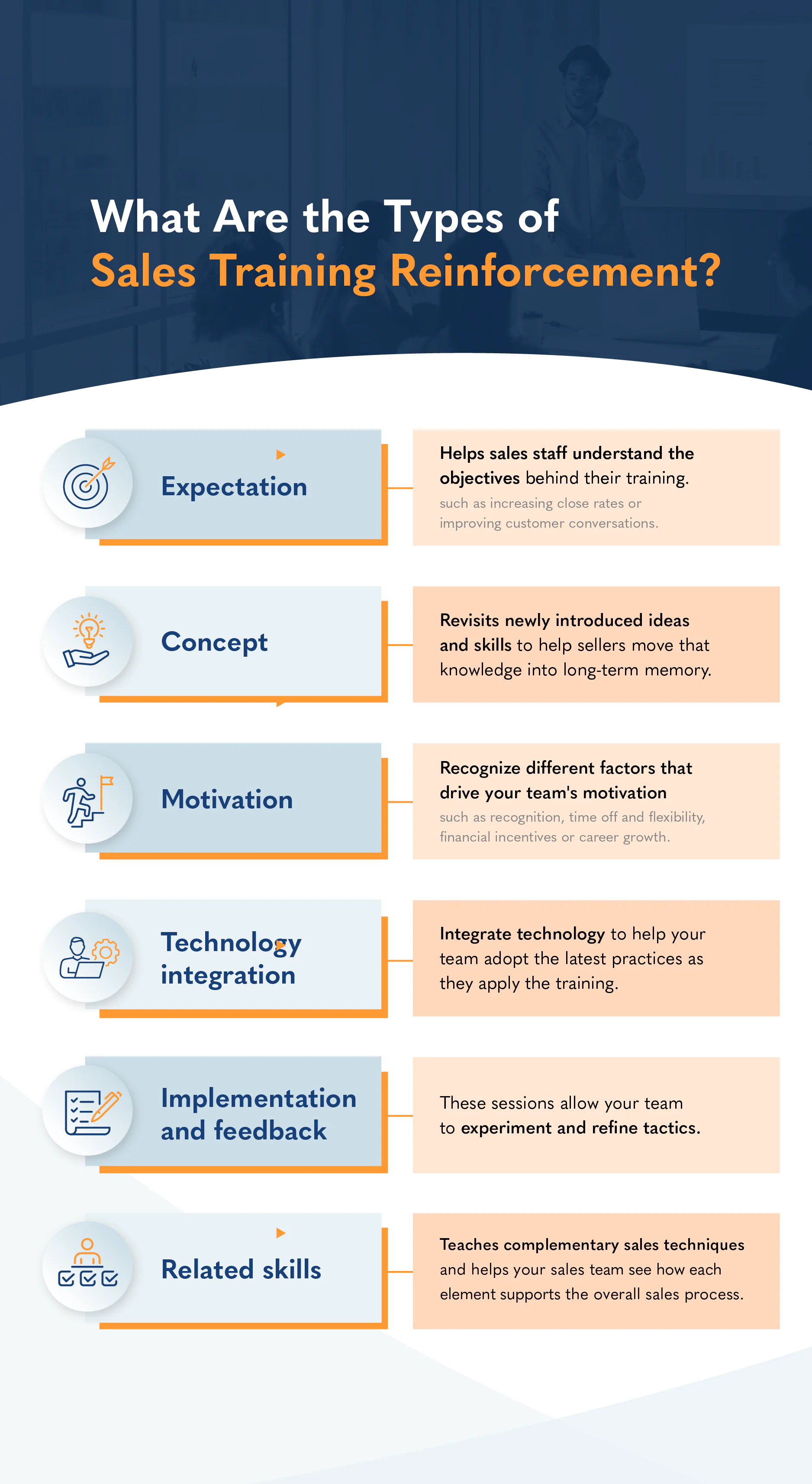
Effective sales training reinforcement involves various approaches that work together to strengthen how your team learns and encourages skill adoption. These areas of reinforcement go on to influence the strategies you use to create a supplementary learning framework that aligns with your performance goals. Here are the different areas of reinforcement learning to focus on:
- Expectation: This aspect of reinforcement helps sales staff understand the objectives behind their training. Every sales program has a unique angle and specific goals, such as increasing close rates or improving customer conversations. Creating a strategy that frequently communicates these goals helps to clarify expectations and keep sellers focused on the outcomes they are working toward.
- Concept: The foundation of reinforcement learning is revisiting newly introduced ideas and skills to help sellers move that knowledge into long-term memory. This is where strategies such as reminders, short refreshers and quick learning touchpoints come in handy to help sellers remember and apply the training.
- Motivation: People have varying motivations. You want to recognize different factors that drive your team’s motivation, such as recognition, time off and flexibility, financial incentives or career growth. All of these are achievable through analyzing feedback. Develop reinforcement programs that leverage these motivations to encourage your team.
- Technology integration: Technology is a big part of reinforcement as it provides tools and systems that align with training goals. The reinforcement program should integrate technology to help your team adopt the latest practices as they apply the training.
- Implementation and feedback: These are critical aspects of reinforcement. When your sales staff practices what they learn, they are better able to develop their skills. These sessions allow your team to experiment and refine tactics. When paired with ongoing feedback, sellers can gradually improve performance based on proven results.
- Related skills: Different sales skills tend to go hand in hand, such as discovery questioning and objection handling. Creating a reformulation framework that teaches complementary techniques deepens understanding. This approach helps your sales team see how each element supports the overall sales process.
What Are the Key Benefits of Reinforcing Sales Training?
Employee retention is already one of the biggest challenges facing organizations. Considering salespeople churn at a much higher rate, it makes sense to understand how reinforcing sales training translates into benefits that impact retention.
1. Improves Performance and Job Satisfaction
When employees underperform, they often feel disengaged and unmotivated, which can lead to resignations. Reinforcing sales training helps employees retain skills designed to improve their performance, which in turn uplifts their morale and overall satisfaction.
Given that well-trained sales teams often meet their top performance metrics consistently, ensuring they have a roadmap — not just for learning, but also for retaining and refining their knowledge — is vital. Consistent performance in a competitive sales environment makes employees proud of their achievements and reduces the pressure that comes with struggling to meet KPIs.
2. Boosts Confidence
How confident a salesperson feels in their role directly correlates to their success within that role. If the initial training leaves them uncertain or confused about the way forward, they may feel underprepared or unsupported.
The expectations of a training program are to provide a clear understanding of the sales process that the organization wants to take. Supplementing this program with follow-up measures allows the sales staff the time to learn what to do and build up the confidence that keeps them engaged in their work.
3. Maintains Accountability
Reinforcement is key to ensuring accountability and helping sales staff realize professional growth. Regular actions such as check-ins, progress tracking and skill challenges allows teams to set and achieve goals. When employees see gradual improvements through daily actions that keep term accountable, they understand what works and are more likely to become invested in their personal growth.
At the same time, ongoing reinforcement signals that learning is a priority, and that creates a culture where improvement is expected and supported.
4. Improves Companywide Alignment
Beyond developing each sales rep’s skills, reinforcement learning creates a culture of alignment that one-time programs rarely establish. When everyone receives ongoing support on the same methods and messaging, it creates a unified sales approach.
A well-aligned team has a consistent process that allows reps to use a similar language and stick to best practices. The consistency of a reinforced approach makes it easier for managers to coach, track performance and scale successful strategies.
5. Makes Staff Feel Valued
Investing in sales training programs shows employees that you are committed to their success. However, that genuine interest in employee development can miss the mark if there is no supportive approach that helps them realize the value of the training.
Reinforcement pushes your sales staff to grow in their role. It creates a progressive structure around performance, encouraging employees to work toward senior sales roles. All of these can make them feel:
- Their career development is valued.
- They are recognized and supported.
- They have a future in the organization.
These factors can make sales employees more comfortable in the workplace and more loyal to the company.
6. Strengthens Work Relationships
Reinforcement learning involves coaching, daily actions, regular feedback and progress tracking. These approaches make managers and sales staff feel less disconnected and more like a team working toward a common goal. This improves the relationship between these groups, which has a direct impact on retention.
When you bridge the gap between the sales team and leadership through supplementary learning and support, you:
- Build better communication, understanding and trust.
- Develop an engaged and informed management team.
- Gain a better understanding of challenges.
What Are Strategies for Reinforcing Sales Training?
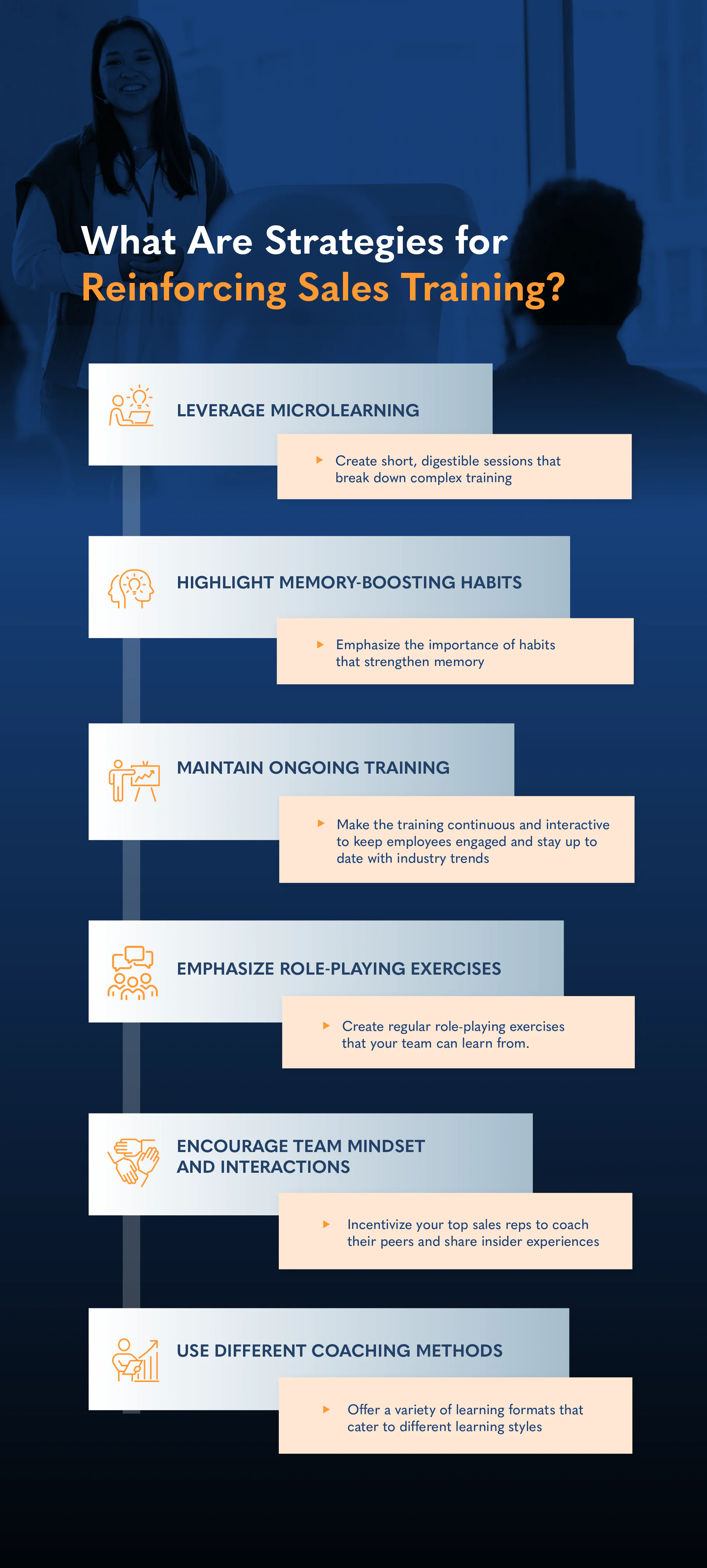
Knowledge retention in sales training comes down to supplementing traditional training with a structured approach to continuous improvement. You will need to integrate reinforcement learning into daily workflows to help your sales team implement what they learn. Here are strategies you can use to reinforce sales training effectively:
- Leverage microlearning: When you dump a ton of information on people, they will likely be overwhelmed and forget most of it. Instead, create short, digestible sessions that break down complex training and build upon each other. These bite-sized modules that clearly connect to a whole topic can be easier for sales staff to understand and remember.
- Highlight memory-boosting habits: Emphasize the importance of habits that strengthen memory, such as good sleep, short learning and review sessions, and quick implementation. Quality sleep may seem unrelated to some of your reps, but it allows the body and brain to recharge, boosting mental clarity. As for immediate implementation, it improves skill mastery through hands-on practice.
- Maintain ongoing training: A one-off training session is far less effective than short, regular sessions. Make the training continuous and interactive to keep employees engaged and stay up to date with industry trends. Find ways to make the learning and growth journey interactive and enticing. Techniques such as gamification can make the learning process more enjoyable. You could incorporate features such as leaderboards and incentives to boost engagement.
- Emphasize role-playing exercises: Create regular role-playing exercises that your team can learn from. These should feature real-life scenarios to help sales staff navigate challenges, enhance skills and maintain confidence. For example, what if a customer asks a question that is not in the script? That lack of information can be demoralizing in the field. However, in mock sessions, that deviation allows teams to refine responses and boost preparedness.
- Encourage team mindset and interactions: While one-time training breeds solo approaches, ongoing reinforcement encourages teamwork and peer mentoring. Due to varying strengths and experiences, performance levels will vary. A team mindset does not leave anyone behind. You can incentivize your top sales reps to coach their peers and share insider experiences that may have a bigger impact than the training.
- Use different coaching methods: Offer a variety of learning formats that cater to different learning styles. You also want to invest in advanced coaching platforms that help with targeted reinforcement, ensuring everyone receives the right support. For example, tools that assess performance and provide personalized training recommendations would be ideal for identifying and meeting each team member’s needs.
Final Thoughts
The impact of reinforcement on sales performance is undeniable. Without sustainment efforts, much of what sales teams learn through training programs degrades over time. Reinforcement learning helps decision-makers make the most of sales training.
More importantly, when salespeople understand and apply what they learn, they are less likely to experience burnout and lack of motivation, which eventually leads to resignations. By investing in continuous reinforcement, companies can foster a resilient, highly skilled and motivated sales force poised for long-term success and growth.


- Why Is Sales Training Alone Insufficient?
- What Is Sales Training Reinforcement Learning?
- How Sales Training Reinforcement Boosts Retention
- What Are the Types of Sales Training Reinforcement?
- What Are the Key Benefits of Reinforcing Sales Training?
- 1. Improves Performance and Job Satisfaction
- 2. Boosts Confidence
- 3. Maintains Accountability
- 4. Improves Companywide Alignment
- 5. Makes Staff Feel Valued
- 6. Strengthens Work Relationships
- What Are Strategies for Reinforcing Sales Training?
- Final Thoughts

- Account Planning (11)
- AI Sales Coaching (21)
- AI Sales Enablement (22)
- AI Sales Technology (23)
- Awards (62)
- Client Testimonial (40)
- Opportunity Management (14)
- Personal Branding (20)
- Podcast (12)
- Research (69)
- Sales Career Development (86)
- Sales Coaching (170)
- Sales Consulting (136)
- Sales Culture (161)
- Sales Enablement (364)
- Sales Execution (24)
- Sales Leadership (114)
- Sales Management (245)
- Sales Negotiation (17)
- Sales Prospecting (122)
- Sales Role-Playing (26)
- Sales Training (250)
- Selling Strategies (257)
- Soft Skills (68)
- Talent Management (93)
- Trusted Advisor (28)
- Uncategorized (1)
- Virtual Selling (43)
- Webinar (13)


