




















The 7 Sales Enablement Capabilities That Turn Sales Training into Execution
 Nick Kane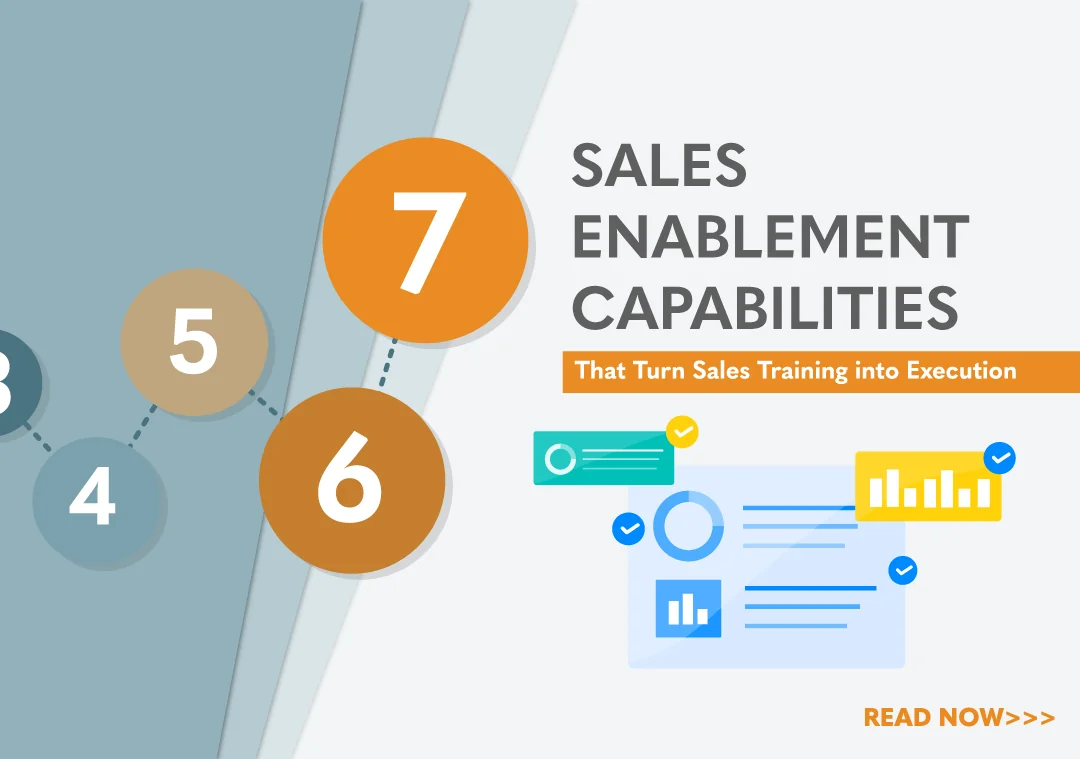
Sales organizations invest heavily in sales training, sales enablement, and technology. The intention is always the same. Improve performance. Increase consistency. Drive better outcomes.
And yet, many sales leaders still feel a familiar frustration: Sales training happens, enablement tools are rolled out, and playbooks are published. Then sellers return to their inbox, their deals, and their very real customers, and execution looks suspiciously similar to before.
This is not a motivation problem. It is not a talent problem. And it is rarely a content problem. It is a sales execution problem.
Modern sales enablement breaks down not because teams lack ideas, but because they lack a system that turns learning into daily selling behavior. To close that gap, sales organizations need seven core sales enablement capabilities working together, not in isolation. Let’s walk through them.
Reinforcement for Retention in Sales Training
(Because memory is not a strategy)
Sales training without reinforcement is like going to the gym once and expecting lifelong fitness. Ambitious. Optimistic. Not how learning works. Sales workshops create momentum, but that momentum fades quickly once sellers return to active pipelines, urgent meetings, and calendars that somehow filled themselves.
Without reinforcement, even strong sales training becomes something sellers vaguely remember agreeing with. Sales reinforcement ensures training does not end when the workshop ends. Concepts, skills, and language resurface in short, structured ways that fit into real selling workflows.
When reinforcement is built into sales enablement:
- Sellers retain sales training longer
- Key ideas appear during live customer conversations
- Knowledge turns into repeatable selling behavior Retention is where sales training ROI actually begins
Practice for Safe Skill Rehearsal
(Because winging it is not a development plan)
Most sellers do not practice sales conversations as often as they should. Not because they do not care, but because practice feels awkward, time consuming, or uncomfortably public. Practicing in front of a manager can feel more like evaluation than development. As a result, sellers often practice on customers, which is brave, but not ideal.
Practice for safe skill rehearsal gives sellers low pressure ways to rehearse messaging, objections, and positioning before real calls. Video responses, short prompts, and AI powered roleplay make practice part of the workflow instead of a separate event. Practice builds confidence. Confidence improves conversation. And better conversations tend to end better for everyone involved.
Application for Sales Execution
(Because knowing the methodology is not the same as using it)
One of the biggest gaps in sales enablement sits between learning a sales methodology and applying it in live deals. Sellers may understand the framework perfectly. Then the call starts, the buyer asks an unexpected question, and muscle memory takes over.
Application for sales execution means sales methodology shows up directly inside the opportunity. Tools, guides, and workflows support sellers as they plan calls, handle objections, and move deals forward. Instead of remembering what to do, sellers are guided through execution in the flow of work. Which turns out to be far more reliable.
Coaching for Sales Performance at Scale
(Because great coaching cannot live only on calendars)
Sales coaching is one of the strongest drivers of performance. It is also one of the hardest to scale. According to a study by the Sales Management Association, sales managers dedicate only about 8 percent of their weekly workload to coaching activities, which works out to roughly 36 minutes per week per salesperson.
That is not a coaching philosophy problem. That is a bandwidth problem. Managers want to coach more. They simply cannot be everywhere at once. Deals move faster than calendars allow, and feedback often arrives after the moment has passed.
Coaching for sales performance at scale means coaching shows up beyond scheduled sessions. Sellers receive guidance through tools, activities, and feedback loops tied to real work. Managers gain insight into where coaching matters most, without needing to review every call manually.
This is where AI for sales plays a practical role, not as a replacement for managers, but as a force multiplier that helps fill the coaching gap when time is limited.
Task Automation for Sales Productivity
(Because sellers should sell, not chase systems)
Ask any seller what slows them down, and the answers are consistent: prep work and admin tasks. Switching between systems just to assemble information that already exists somewhere else.
Task automation for sales productivity reduces friction without replacing sellers. By bringing relevant content, tools, and data together at the right moment, automation simplifies preparation and reduces context switching. The result is more customer facing time and less time spent hunting for information. Which, conveniently, is why sellers were hired in the first place.
Measurement for Sales Enablement Impact
(Because activity does not equal effectiveness)
Sales enablement leaders are under pressure to prove impact. Attendance numbers and completion rates are easy to report. Behavior change and deal impact are harder. Measurement for sales enablement impact connects learning, practice, coaching, and execution to outcomes that matter. Leaders can see what is being used, what is working, and where execution gaps still exist.
This visibility changes the conversation. Sales enablement moves from defending its value to improving it.
Continuous Learning for Sales Knowledge Transfer
(Because buyers expect more, not less)
Buyers are more informed and more demanding than ever. According to Salesforce research, 86 percent of business buyers are more likely to buy when companies demonstrate a clear understanding of their goals.
That level of understanding does not come from one time training. It comes from continuous learning, better conversations, and coaching that adapts to real buyer signals.
Continuous learning for sales knowledge transfer means learning happens in the flow of work. Sellers learn by doing, asking questions, receiving feedback, and applying insights from real customer interactions. When learning is continuous, sellers are better equipped to engage buyers with relevance and context, not scripts.
The Role of AI in Connecting It All
Sales leaders know AI matters, even if they are still figuring out how to use it effectively. According to Salesforce, 78 percent of sales leaders say they are concerned about missing out on generative AI. That concern is not about shiny features. It is about fragmentation.
Most sales teams already have plenty of tools. What they lack is connection. AI becomes powerful when it connects data, conversations, and workflows into a single system that supports sellers in real time. This is where AI for sales moves from hype to utility.
Bringing the 7 Sales Enablement Capabilities Together
Individually, each capability improves sales performance. Together, they create a system that turns sales training into execution.
- Reinforcement improves retention.
- Practice builds confidence.
- Application drives consistency.
- Coaching scales performance even when managers lack time.
- Automation restores selling time.
- Measurement proves impact.
- Continuous learning sustains growth.
This is what modern sales enablement and AI driven sales execution look like when they are designed for real sellers doing real work.
To see how each of these capabilities comes to life, watch the embedded videos and explore how Jenius CC brings them together into a single execution system.
Frequently Asked Questions About Sales Enablement, AI, and Sales Execution
What is sales enablement?
Sales enablement is the discipline of equipping sales teams with the training, tools, content, coaching, and insights they need to execute effectively in customer conversations. Modern sales enablement focuses on turning learning into daily selling behavior, not just delivering training events.
Why does sales training fail to stick?
Sales training often fails to stick because it lacks reinforcement. Without ongoing reinforcement in the flow of work, sellers forget new skills quickly once they return to active deals, meetings, and inbox pressure. Retention requires continuous reinforcement, not one-time workshops.
How does reinforcement improve sales performance?
Reinforcement improves sales performance by helping sellers recall and apply training at the moment it matters. When key concepts and skills resurface during deal preparation or customer conversations, sellers build habits instead of relying on memory alone. This leads to more consistent execution and higher confidence.
Why is sales coaching hard to scale?
Sales coaching is hard to scale because managers have limited time. Research shows sales managers spend only a small portion of their week coaching individual sellers. Without support, coaching becomes inconsistent and reactive. Scalable coaching requires tools and AI that support sellers between formal coaching sessions.
How does AI support sales enablement?
AI supports sales enablement by connecting data, conversations, tools, and workflows into a single system. AI can surface coaching moments, guide sellers through best practices, analyze call interactions, and deliver contextual support in real time. This allows enablement to operate continuously rather than episodically.
What is AI for sales execution?
AI for sales execution refers to using artificial intelligence to help sellers apply skills, processes, and methodologies in live deals. Instead of replacing sellers, AI supports preparation, coaching, decision making, and follow through, helping sellers execute more consistently across opportunities.
How does continuous learning improve buyer engagement?
Continuous learning helps sellers stay relevant as buyer expectations change. When sellers learn from real interactions, receive feedback, and apply insights in the flow of work, they are better equipped to understand buyer’s goals and tailor conversations. This leads to stronger engagement and better outcomes.
What should sales leaders look for in a sales enablement platform?
Sales leaders should look for a platform that connects training, reinforcement, practice, coaching, automation, measurement, and continuous learning into one system. The platform should fit into existing workflows, support sellers in real time, and provide visibility into what is working across the sales organization.
How does Jenius support modern sales enablement?
Jenius supports modern sales enablement by acting as the orchestration layer between sales training, coaching, tools, and AI. It helps ensure that learning shows up in execution, coaching scales despite time constraints, and sellers receive the right support at the right moment.


- Reinforcement for Retention in Sales Training
- Practice for Safe Skill Rehearsal
- Application for Sales Execution
- Coaching for Sales Performance at Scale
- Task Automation for Sales Productivity
- Measurement for Sales Enablement Impact
- Continuous Learning for Sales Knowledge Transfer
- The Role of AI in Connecting It All
- Bringing the 7 Sales Enablement Capabilities Together
- Frequently Asked Questions About Sales Enablement, AI, and Sales Execution

- Account Planning (11)
- Awards (53)
- Client Testimonial (37)
- Personal Branding (19)
- Podcast (12)
- Research (70)
- Sales Career Development (85)
- Sales Coaching (156)
- Sales Consulting (133)
- Sales Culture (164)
- Sales Enablement (349)
- Sales Leadership (111)
- Sales Management (243)
- Sales Negotiation (16)
- Sales Prospecting (120)
- Sales Role-Playing (19)
- Sales Training (234)
- Selling Strategies (256)
- Soft Skills (68)
- Talent Management (92)
- Trusted Advisor (28)
- Virtual Selling (42)
- Webinar (12)