




























A Guide on Sales Methodologies to Win Large Deals
 Justin Zappulla
- What Is a Sales Methodology?
- Benefits of Using the Right Sales Methodologies
- What Unique Challenges Do Large Deals Present to Sales Teams?
- The Consensus Conundrum
- Nonlinear Buying Journeys
- Risk Aversion and the Status Quo
- Resource Drain
- What Makes an Effective Sales Methodology?
- A Clear Framework
- Customer-Centricity
- Adaptability and Continuous Improvement
- Alignment With Business Goals
- Training and Coaching
- How Do You Choose the Right Sales Methodology for Your Business?
- Win Large Deals, Impress Prospects
Securing large deals presents distinct challenges. The stakes are higher, the buying journey is often lengthier and success requires a structured, strategic approach. Large deals require your sales team to do things differently, paying closer attention to proven sales methodologies. With good methodologies, you go beyond closing deals — you build alignment, credibility and long-term value.
Many sales methodologies exist. However, not all of them are built to accommodate the complexity of large, high-value deals. To help you narrow down and understand your options, Janek Performance Group has put together this detailed guide.
What Is a Sales Methodology?
A sales methodology is a structured framework that guides and regulates sales teams through the sales process. Think of it as a detailed roadmap that teams can follow throughout each sales journey, from first contact through conversion and beyond. Sales methodologies leverage AI, data and buyer insights to build repeatable structures that deliver consistent results.
Benefits of Using the Right Sales Methodologies
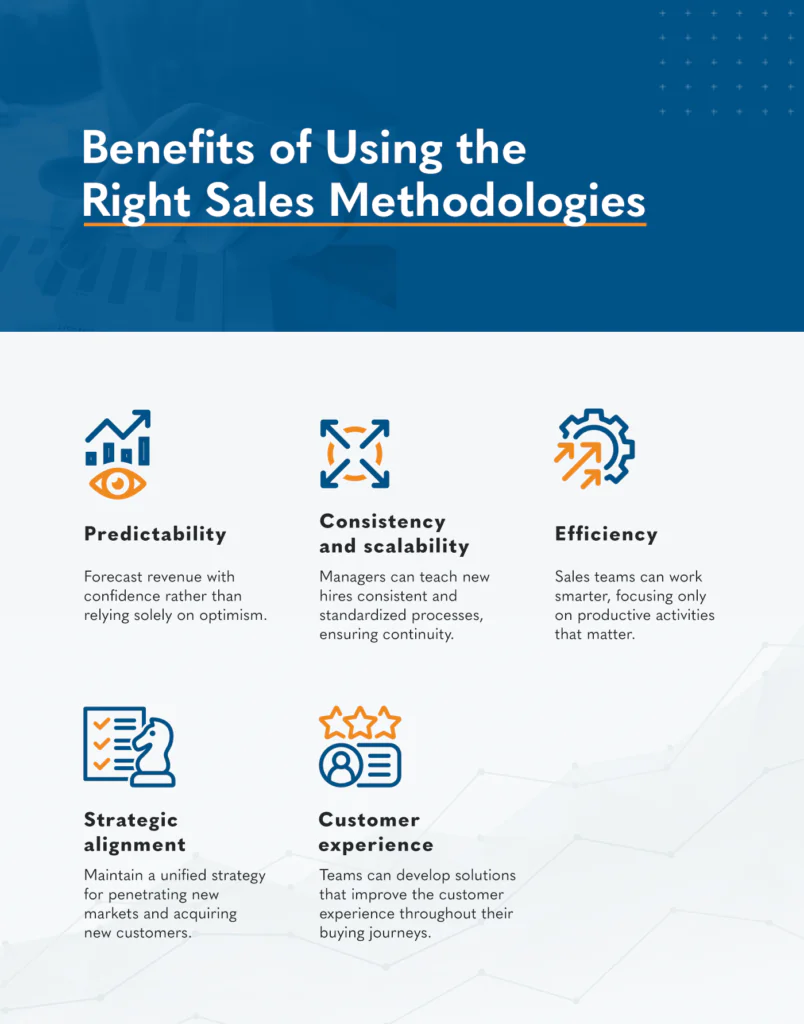
Some key advantages of using an effective sales methodology are:
- Predictability: A sales methodology removes the guesswork from the sales process, replacing it with repeatable, data-backed systems that team members can follow. This benefit enables leadership to forecast revenue with confidence rather than relying solely on optimism.
- Consistency and scalability: It’s easier to scale proven outcomes when you rely on sales methodologies. Managers can teach new hires consistent and standardized processes, ensuring continuity. Sales methodologies also make it simpler for teams across different regions and locations to maintain the same high-quality selling standards.
- Efficiency: By using structured frameworks and tested roadmaps, sales teams can work smarter, focusing only on productive activities that matter.
- Strategic alignment: With a clearly defined sales methodology, sales teams can easily align their efforts with the company’s broader objectives. This alignment is crucial to maintaining a unified strategy for penetrating new markets and acquiring new customers.
- Customer experience: Sales methodologies help sales teams better understand their customers’ unique needs. Teams can develop solutions that improve the customer experience throughout their buying journeys.
What Unique Challenges Do Large Deals Present to Sales Teams?
Large deals generate significant revenue, create long-term value and accelerate growth. However, they also present unique challenges to sales teams. Understanding and tackling these challenges is key to realizing the full potential of high-value opportunities. Let’s examine some of the challenges your sales team may encounter on their quest to win large deals.
The Consensus Conundrum
Since large deals require mobilizing multiple stakeholders, reaching consensus can be more challenging. This challenge is even more prevalent when stakeholders have varying and conflicting priorities and pain points. In this case, the decision-making process can drag or grind to a halt when competing priorities create gridlocks.
Here are some steps you can take to resolve this challenge:
- Create a stakeholder map: Identify the key stakeholders and their roles in the decision-making process. Sales team managers should also identify a champion stakeholder who can influence other stakeholders to reach a consensus more quickly. It’s crucial to do this early in the process, before bottlenecks arise.
- Leverage structured reviews: Guide each stakeholder through the entire process, keeping them engaged from start to finish. One way to do this is to implement a structured review process that allows stakeholders to share their views and perspectives on a deal. This way, the sales team can better understand each stakeholder’s distinct priorities and pain points.
- Employ a tailored communication approach: Carry every stakeholder along and keep them informed at each stage. Turn every communication into a clear and creative two-way conversation, tailoring the messaging to suit different personas. Doing this can make it easier to address unique pain points and resolve misconceptions quickly.
- Utilize your champion stakeholder: If reaching consensus becomes challenging, leverage your champion stakeholder to build momentum and influence key decision-makers.
Nonlinear Buying Journeys
Large deals are inherently nonlinear and often characterized by looping, stalling or regressing rather than advancing through seller-defined stages from initiation to closure. The reasons for this structure range from complex stakeholder management and intense negotiations to the high-stakes risks involved in such deals. The back-and-forth in large deals makes it harder for sales teams to determine where the deal stands, leading to unrealistic expectations and unreliable forecasting.
Depending on the unique circumstances of each deal, your sales team can take the following steps to adapt:
- Multithreading: Multithreading is a strategy that involves engaging multiple stakeholders simultaneously across departments to increase win rates. In a buying journey that rarely moves in a straight line, multithreading helps close the gaps where large deals typically stall.
- Micro-commitments: Sales teams can focus on securing a series of smaller, incremental agreements rather than solely pursuing the ultimate commitment. Large deals thrive when there is sustained engagement over long periods. Since buyers typically engage and disengage at different phases, micro-commitments help maintain forward momentum, even when the journey isn’t linear.
- Anticipation and preparation: While predicting outcomes at each phase of the sales cycle may be difficult, sales teams can proactively anticipate various possible paths and detours. With these likely paths in mind, they can prepare relevant resources and tools in advance, rather than passively waiting for the buyer to dictate the process.
Risk Aversion and the Status Quo
Large deals often involve substantial financial commitments and significant risks. There’s the possibility of making wrong decisions that can lead to financial losses, reputational damage and other consequences. As such, buyers and stakeholders are more likely to scrutinize large deals closely to avoid adverse outcomes, resulting in longer sales cycles and analysis paralysis. Additionally, there may be requests for guarantees of success, which is rarely possible.
Closely related to this fear of failure is the tendency for stakeholders to prefer the “do nothing” option over taking risks. Instead of agreeing to large, riskier deals, some stakeholders may choose to maintain the status quo, even if their current systems have flaws and are merely good enough.
Certain strategies may help address these challenges:
- De-risk the deal: You can’t guarantee that large deals are entirely risk-free. However, you can break the significant, intimidating decisions down into a series of lower-stakes agreements. This reduces the pressure and reframes the deal as multiple smaller advances rather than a single all-or-nothing move.
- Provide social proof and validation: Leverage case studies and customer testimonials that involve similar companies and challenges. By demonstrating expertise and showcasing past successes, sales teams can reduce the fear that buyers and stakeholders may have of being test subjects.
- Articulate a compelling vision: The status quo will remain the better, safer option until buyers and stakeholders can recognize its inefficiencies and lapses. One strategy to address the status quo challenge is to present a compelling narrative that underscores the need for change.
Resource Drain
Many resources go into winning and closing large deals. For instance, sales teams have to stay committed to a single opportunity that can span several months, if not a year or more. Similarly, each deal may require multiple meetings, presentations and negotiation rounds, all of which can drain resources. Some may necessitate hiring specialists to tackle hurdles as they arise. In the long run, large deals may yield significant returns on investment. However, if a large deal fails, the revenue impact can be severe.
Sales teams require strategic approaches to address resource drain in large deals amid nonlinear buying journeys. Some of these strategies include:
- Rigorous qualification and disqualification: Before the sales team expends a single resource toward pursuing a large deal, they should implement strict, objective qualification criteria. This may help prevent resource drain by disqualifying unsuitable deals early.
- Core sales team empowerment: Provide extensive training for core sales team members on navigating the complexities involved in large deals. When they are trained to become self-sufficient, there may be little or no need to hire specialists.
What Makes an Effective Sales Methodology?

Effective sales methodologies combine several key elements that work together to gear sales teams toward successful outcomes. Outlined below are a few of these core elements.
A Clear Framework
For a sales methodology to be effective, there should be a clear framework that provides sales team members with a consistent structure. This way, everyone on the team understands their roles and the steps and processes involved at each stage of the sales cycle.
The benefits of a clear framework are numerous, including increased team engagement, efficiency and effectiveness. Ultimately, a clear framework contributes to repeatability, ensuring that every team member can achieve the same results.
Customer-Centricity
Sales methodologies are more effective when each stage of the sales process focuses on the customer’s needs, challenges and opportunities. This approach prioritizes the customer above the need to sell a product or service. For this reason, sales team members should receive proper training in active listening, empathy and providing solutions with the customer’s best interests at heart.
Adaptability and Continuous Improvement
Market conditions, consumer behavior and product offerings often change. An effective sales methodology is flexible, allowing for continuous improvement and adaptation as markets change. To maintain this adaptability, teams should be trained to collect feedback, analyze performance and make the adjustments necessary for growth.
Alignment With Business Goals
A sales methodology, including the entire sales process and the strategies involved, must align with the overarching business goals to be effective — especially when dealing with large deals. When there is alignment, every move and metric contributes to the overall business objectives, not detracts from them. Additionally, an aligned sales methodology serves as a feedback loop, validating or challenging your organization’s long-term direction.
Training and Coaching
Effective sales methodologies require proper training and coaching to drive successful execution. New team members should undergo initial onboarding, during which they will learn everything they need to know about specific sales methodologies and the philosophies that underpin them. Similarly, existing team members should receive regular training to refine their understanding and application of relevant sales methodologies.
The following steps are crucial for making the most of the training and coaching:
- Proper analysis and planning: Start by analyzing the specific training needs of sales team members, from strengthening communication to improving core selling skills. This step helps you target areas that need improvement and measure the training’s outcomes.
- Preparation and alignment: Using the information gathered from the needs analysis, you can prepare and tailor relevant training to meet those needs already outlined. It’s also vital to tailor the training delivery to account for factors such as class size, member location and training sustainment. For instance, an in-person training delivery method may not work when sales team members are dispersed across states or countries — an online or blended approach may be more effective and practical.
- In-depth learning and practice: Effective training equips salespeople with the necessary knowledge and tools to learn and improve their skills. They also include activities like role-play sessions, where trainees can practice their refined skills.
- Assessment and reporting: Assessment is an invaluable next step after sales training for several reasons, including feedback collection and measurable learning validation.
- Ongoing learning and reinforcement: Finally, the training shouldn’t end after the time scheduled for the exercise. Plans should be in place for training reinforcement, ongoing sales coaching and self-paced learning.
How Do You Choose the Right Sales Methodology for Your Business?
No two sales methodologies are alike — while some principles may overlap, each is unique. Depending on the nature of the deal, you may be able to mix and match different methodologies. However, it’s essential to know how to choose the right fit for your business. Some factors to consider before choosing include:
- Complexity of products or services: Complex products require methodologies that focus on deep discovery and intricate problem diagnosis. Certain methodologies may be better suited to such products, while simpler solutions might lean toward more direct approaches.
- Team capabilities: Some methodologies are more complex than others. Similarly, some are more intense to learn and master than others. Consider the skill and capability levels of your current sales team members. When your solutions are complex and require highly skilled reps, it’s ideal to invest in enterprise sales training.
- Target audience: Learn more about your target audience to understand who they are, how they think and their level of sophistication. If they are highly informed and research-driven, methodologies that emphasize insight may resonate more with them.
Win Large Deals, Impress Prospects
Winning large deals requires a strategic blend of skill, tact and the right sales methodologies. With a well-executed sales methodology, your sales teams can navigate complex, high-stakes deals with confidence and consistency — impressing prospects and potentially winning them over.


- What Is a Sales Methodology?
- Benefits of Using the Right Sales Methodologies
- What Unique Challenges Do Large Deals Present to Sales Teams?
- The Consensus Conundrum
- Nonlinear Buying Journeys
- Risk Aversion and the Status Quo
- Resource Drain
- What Makes an Effective Sales Methodology?
- A Clear Framework
- Customer-Centricity
- Adaptability and Continuous Improvement
- Alignment With Business Goals
- Training and Coaching
- How Do You Choose the Right Sales Methodology for Your Business?
- Win Large Deals, Impress Prospects

- Account Planning (11)
- AI Sales Coaching (20)
- AI Sales Enablement (21)
- AI Sales Technology (22)
- Awards (61)
- Client Testimonial (40)
- Opportunity Management (14)
- Personal Branding (19)
- Podcast (12)
- Research (69)
- Sales Career Development (86)
- Sales Coaching (169)
- Sales Consulting (135)
- Sales Culture (161)
- Sales Enablement (364)
- Sales Execution (23)
- Sales Leadership (114)
- Sales Management (245)
- Sales Negotiation (17)
- Sales Prospecting (120)
- Sales Role-Playing (26)
- Sales Training (248)
- Selling Strategies (256)
- Soft Skills (68)
- Talent Management (93)
- Trusted Advisor (28)
- Uncategorized (1)
- Virtual Selling (43)
- Webinar (13)


